 من بيروت
The State Lebanon Never Built
For decades, Lebanon has been governed not as a nation of citizens but as a federation of patronage networks. The consequences are no longer manageable. A civic state is not a reform option. It is the only option.
By: Farid Fakherddin
Lebanon is not a failed state in the conventional sense. Its restaurants, 5ll, its airports move, its diaspora remits. But beneath this surface activity lies a governance structure that has never properly formed: a state that exists on paper, functions in fragments, and serves communities rather than citizens.
The country’s instability is not the product of bad luck or hostile geography. It is the product of a political architecture deliberately built around the preservation of communal power rather than the construction of a shared public order. That architecture has now reached its limits.
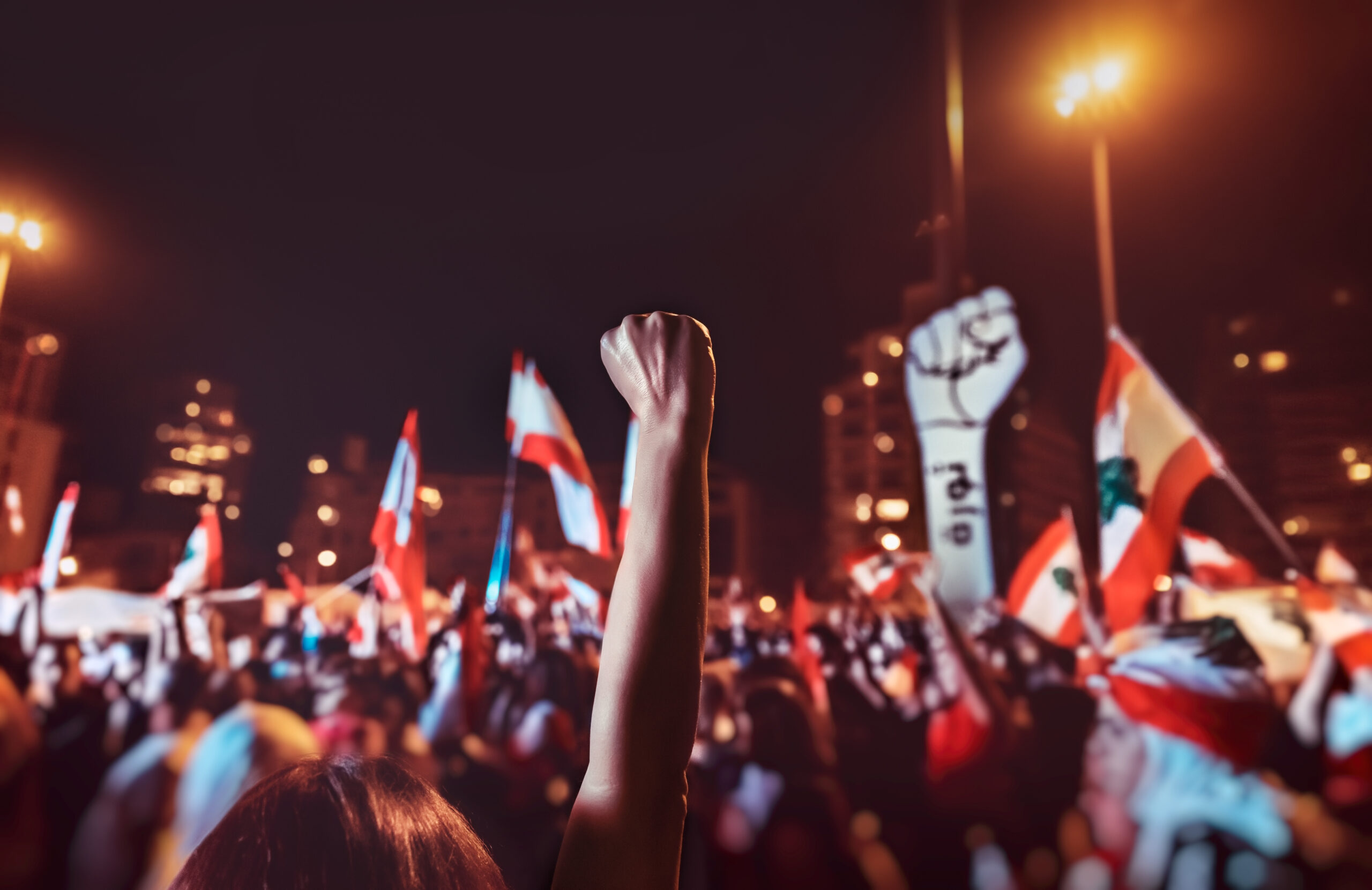
Beirut, October 2019. Hundreds of thousands of Lebanese gathered in Martyrs Square and across the country during the October 17 Revolution, demanding the fall of the entire political class under the slogan “All of them means all of them.” The uprising was Lebanon’s most significant civic rupture in a generation.
A GOVERNANCE SYSTEM WITHOUT CITIZENS
Since Lebanon’s founding Constitution of 1926, political representation has been organized by sect, not by individual. The consequences run deep. Rights Grow through communities rather than through law. Loyalties attach to a “za’iim” and a party rather than to the republic. Public services become instruments of clientelism, not entitlements of citizenship. The individual Lebanese is, in the language of political theory, a subject of a community rather than a citizen of a state.
“Lebanon is a country where communities fear the state as much as they fear each other.”
SAMIR KASSIR , HISTORIAN AND JOURNALIST (1960 – 2005)
FEUDALISM IN A MODERN COAT
What has emerged over generations is a modern feudalism, one that wears the language of democracy while operating through inherited power, dependency, and controlled access. Political families reproduce themselves across elections. Economic opportunity passes through brokers, fixers, and patrons. Loyalty is purchased with favors and punished with exclusion. This is not a dysfunction within the system. This is the system.
Its effects are predictable and well-documented: accountability hollowed out, meritocracy absent, institutions captured. The Lebanese state does not fail because it lacks resources or capable people. It fails because the incentive structure of its political class is built on preventing it from working.
THE WAR THAT NEVER ENDED POLITICALLY
The Civil War of 1975 to 1990 did not produce a political transition. It produced a settlement. The Taif Agreement ended military violence but preserved the logic of the militia: that power is communal, that force underpins negotiation, and that the state is an arena to be divided rather than an institution to be built. Warlords became parliamentarians. Militias became parties. Their networks became the arteries of the postwar economy.
Lebanon did not transition from militias to a state.
It integrated militias into the state and called the result governance.
SOVEREIGNTY AS A CONTESTED CONCEPT
No analysis of Lebanon’s condition is complete without confronting Hezbollah directly. The organization operates a military force, a social services network, a foreign policy, and a veto over the Lebanese state,all simultaneously. It is the most visible instance of a broader structural problem: that Lebanon contains multiple centers of authority, and the formal state is only one of them. Elected officials negotiate with actors who hold weapons. Institutions issue decisions that armed factions can override. The result is not dual authority. It is a hierarchy in which the state occupies a subordinate position.
“A country is not merely soil; a country is an idea.”
CHARLES MALIK, LEBANESE PHILOSOPHER AND STATESMAN (1906 – 1987)
THE RESILIENCE TRAP
Lebanon survives, and this survival is routinely celebrated as proof of national character. The private sector adapts. The diaspora provides a lifeline. Entrepreneurs build around the dysfunction. But resilience of this kind has become a trap. It reduces the pressure for structural change. It absorbs costs that should be politically unsustainable. It allows a dysfunctional system to persist far beyond the point at which its costs should have forced a reckoning. Lebanon does not need more resilience. It needs a functioning state that makes extraordinary resilience unnecessary.

Nejmeh Square, Downtown Beirut. The Lebanese Parliament building
WHY FEDERALISM AND PARTITION FAIL THE TEST
When the system reaches crisis, the proposals that emerge tend toward structural reorganization: federal cantons, confederal arrangements, soft partition. These ideas are not solutions. They are relocations of the problem. Fragmenting Lebanon geographically does not eliminate patronage networks; it franchises them. It does not create citizens; it creates subjects of smaller fiefdoms. The root failure is not geographic, it is constitutional and political. Only a reconstitution of the relationship between the individual and the state can address it.
A FRAMEWORK FOR TRANSITION: THREE PILLARS
I. Sovereignty
The Lebanese state must become the sole legitimate holder of armed authority within its territory. This is not a negotiating position. It is the minimum definition of a state. All parallel military structures must be dissolved or absorbed under united civilian command. Institutional independence, of the judiciary, the central bank, the civil service, must be structurally guaranteed, not politically granted and withdrawn.
II. Stability
The rule of law must apply without exception and without the mediation of political patrons. This requires judicial reform that is insulated from sectarian appointment, administrative reform that severs the link between service delivery and party loyalty, and a culture of institutional accountability that is reinforced rather than selectively applied. Stability is not the absence of crisis. It is the presence of predictable, enforceable rules.
III. Prosperity
Economic recovery requires the decoupling of economic opportunity from political access. This means dismantling the rent-seeking structures that concentrate wealth in the hands of political networks, enabling competitive markets that function on merit rather than connection, and systematically engaging the Lebanese diaspora as partners in reconstruction rather than as a remittance source to be passively drawn upon.
CITIZENSHIP AS THE FOUNDATION
At the heart of every institutional failure described in this paper lies the same absence: a political order in which the individual stands in direct relationship to the state, not mediated by sect, family, or patron. Citizenship is not merely a legal category. It is a political culture, a set of expectations about rights, duties, and accountability that must be built deliberately and defended consistently. Lebanon has citizens. It does not yet have citizenship.
CONCLUSION
The Lebanese state is not fragile because Lebanon is uniquely unlucky or uniquely divided. It is fragile because the system built after independence, and rebuilt after the war, was never designed to produce a functioning state. It was designed to manage competing communities. That design has exhausted itself.
What remains is a choice between two futures. The first is a continuation of managed fragmentation: periodic crises absorbed by resilience, occasional reforms absorbed by the system, and a slow erosion of whatever institutional capacity survives. The second is a deliberate, structured transition toward a civic state, one built on the consolidation of sovereignty, the rule of law, and an economy decoupled from political patronage.
That transition will not happen through goodwill or through foreign pressure alone. It requires political actors willing to dismantle the very systems through which they hold power, and a Lebanese public willing to demand that they do. The moment for that demand, and that decision, is now.